|
|
|
|
|
|
Hiking Information
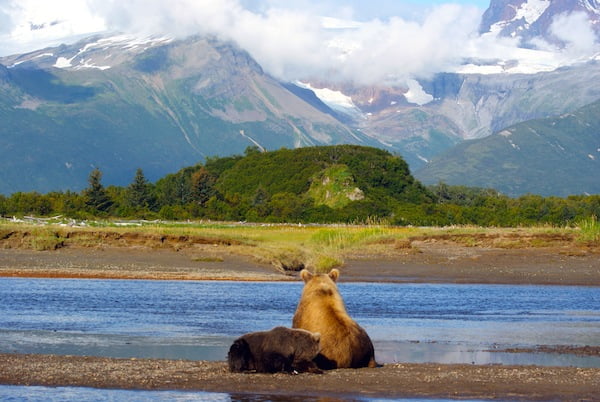
Variety marks this vast land: lakes, forests, mountains, and marshlands all abound in wildlife. The Alaska brown bear, the world's largest carnivore, thrives here, feeding upon red salmon that spawn in the many lakes and streams. Wild rivers and renowned sport fishing add to the attractions of this subarctic environment. Here, in 1912, Novarupta Volcano erupted violently, forming the ash-filled "Valley of Ten Thousand Smokes" where steam rose from countless fumaroles. Today only a few active vents remain. The park-preserve contains part of the Alagnak Wild River.
Hiking in Katmai National Park can be a fun and rewarding experience as in other national parks. It is a great way to both see and experience the park.
Katmai is a vast wilderness of deep, cold lakes, long scenic valleys, volcanic landscapes, and a diverse seacoast. Located at the northern end of the Alaska Peninsula, this rugged country offers opportunities for long crosscountry backpack trips or short day hikes. Boaters can canoe, float or kayak lakes, rivers and streams in Katmai. With adequate preparation, proper equipment and certain skills and knowledge, the hiker can have a safe, memorable experience.
You may obtain a free backcountry planner at Katmai Headquarters in King Salmon or the Brooks Camp Visitor Center. You will be asked to give an itinerary and emergency contact information. Katmai National Park and Preserve will NOT initiate a search unless someone reports you as overdue. Inquire about conditions and hazards before you head out and by sure to check in with the staff when you return.
Katmai National Park and Preserve has nearly 4 million acres of wilderness, yet there are only two identified hiking trails.
| Trail | Length | Description |
| Dumpling Mountain | 4.0 miles | This trail starts at Brooks Camp and climbs to the overlook, then continues to the summit. |
| Ukak Falls | This trail begins at Three Forks cabin at the end of the Valley Road. It climbs 700 feet down to Ukak Falls at the edge of the Valley of 10,000 Smokes. |
The Valley of 10,000 Smokes
Daily flights from King Salmon to Brooks Camp are scheduled from 1 Jun to mid-Sep. Bus tours along the road to the valley are also scheduled during this period. For those wishing to hike or camp in the Valley, arrangements can be made with the park concessioner to take the bus out one day and be picked up later to return to Brooks Camp. A fee is charged for this service.
Strong winds create the most treacherous conditions. Winds generally blow across Katmai Pass and can reach speeds exceeding 50 mph on the Valley floor. Even the sturdiest tents are tested in such conditions, so always look for a protected area to pitch your tent. The ash blow up by the wind is extremely uncomfortable; goggles are recommended.
River crossings are necessary for any trip to the valley. To enter the Valley, hikers must cross Windy Creek. The River Lethe runs down the center of the upper valley and must be crossed to reach Baked Mountain and Novarupta Food and Supplies
Bring your food, equipment and other supplies with you. Limited selections of freeze dried foods are available at Brooks Camp, but it is recommended that you have all food packed prior to arriving in Katmai. Avoid food such as bacon or smoked fish, soaps, and cosmetics with strong odors as they attract bears. Bottles and cans are hard to dispose of. If you take them in, you are expected to carry them out. A limited number of bear resistant food containers are available for use at Brooks Camp and from the King Salmon Visitor Center. Without some sort of bear proof storage, you should be prepared to hang your food as high as possible. Federal Aviation Administration regulations prohibit carrying fuel in containers such as stoves on commercial airlines. White gas is available for purchase at Brooks Camp.
Backcountry Travel
The staff at Katmai National Park urges you to stop by, write to or call the offices in King Salmon or Brooks Camp for help in the final planning of your trip. A variety of terrain can be encountered. Some is easy walking, but streams must be crossed and glacier or mountaineering experience may be needed to climb the surrounding mountains. Depending on the mountain's condition, crampons and ropes may be needed on the snow or ice fields. Steeper slopes require an ice axe.
There are no maintained backcountry trails and only a few backcountry shelters. The best hiking routes are along river bars, lake shores, and gravel ridges. Even on the best routes, you must occasionally cross rivers or fight through dense brush or marshy flats. Routes often selected are wildlife trails. Stay alert for bears and moose as you travel as wildlife also seeks the easiest routes through brush and forest.
Stay away from low-lying tundra flats because tussocks and marshy ground predominates there, making hiking extremely difficult. The mosquito is king in this environment. Alder thickets on hillsides, and willow patches along the water courses are often impenetrable. They may also hide bears. Be sure to make noise.
The rivers in the Valley of Ten Thousand Smokes cannot be approached using traditional river crossing techniques.
Several of the rivers are actually narrow gorges, formed as water cuts through the deep layers of ash. Canyons in these river gorges are as deep as 100 feet in places. The rivers are very silt laden as they carry tons of volcanic ash downstream. There is little possibility of judging water depth.
The river gorges are constricted in places, and water is able to rise and fall rapidly depending on weather conditions, snow pack, etc. In several spots, deep gorges fill in a matter of hours and water spills out, forming what appears to be wide and flat bodies of water. It is easy to misread the river under these conditions. Someone thinking in terms of traditional river crossing techniques may choose the very worst spot to cross. A deep uncrossable gorge may be hidden beneath a wide flat section of water.
Hikers in the Valley must understand these dangers and must be prepared to encounter conditions when crossing river gorges is not possible. On the River Lethe there are several "jump spots" where the gorge is so constructed you can step across. Of course, during high water conditions, these jump spots may also be underwater. IF YOU CANNOT FIND A JUMP SPOT AND YOU ARE UNFAMILIAR WITH JUMP SPOTS, YOU SHOULD NOT ATTEMPT A CROSSING. It is far better to wait a day or two until the lower water levels permit a safe crossing.
Rivers in the Valley are constantly changing. Ash sloughs off the canyon walls and erosion changes the river channels. Because of the constant change, the park cannot recommend a particular crossing spot.
Emergency gear
Waterproof matches in airtight containers, metal matches, fire starter and �tinder' are suggested. Extra food and clothing, a signal mirror, smoke flare, durable space blankets, plastic bags, and a good first aid kit are extremely valuable if you plan on being out for several days. Cord can be used to make a shelter and hang food in trees. Most hikers carry water purification filters or chemicals. Some even carry pocket strobe lights, and a few carry personal locator beacons. Plan to be self sufficient in any emergency. The land is vast and remote, and you cannot count on early help if you have difficulties.
Equipment
Try and keep your gear lightweight yet durable. Equipment should withstand rigorous use in a rough, mountainous countryside. Help could be many hours away should something go wrong with your gear.
Food and Supplies
Bring your food, equipment and other supplies with you. Limited selections of freeze dried foods are available at Brooks Camp, but it is recommended that you have all food packed prior to arriving in Katmai. Avoid food such as bacon or smoked fish, soaps, and cosmetics with strong odors as they attract bears. Bottles and cans are hard to dispose of. If you take them in, you are expected to carry them out. A limited number of bear resistant food containers are available for use at Brooks Camp and from the King Salmon Visitor Center. Without some sort of bear proof storage, you should be prepared to hang your food as high as possible. Federal Aviation Administration regulations prohibit carrying fuel in containers such as stoves on commercial airlines. White gas is available for purchase at Brooks Camp.
Footwear
Boots should be a sturdy hiking or mountaineering type that provides good ankle support. Some hikers prefer boots with the rubber shoe and leather upper, like the Maine Hunting Shoe. You can count on your feet getting wet regardless of your boot type, so durability and support should be a prime concern. Many pair of socks are essential. Tennis shoes are good for crossing rivers.
Insects
Insect repellent and head nets are highly recommended.
Map
The most common topographic maps are available at the King Salmon and Brooks Camp Visitor Centers.
Rain gear and clothing
Durable rain gear that covers both the upper and lower torso is a must for hikes of any length. The rain gear should keep out water in a steady down pour. Since you will eventually get wet in any significant rain storm, wool or synthetic clothing that insulates when wet is highly recommended for wear under rain gear. The weather in Katmai can change quickly and without warning. Expect rain and drizzle. Summer temperatures range up to 65�, while lows do not drop below 50�. Hypothermia is always a possibility with wet conditions and cool temperatures.
Stove
A gasoline stove is essential. Wood is scarce and often wet. Wood is usually unavailable in the Valley of Ten Thousand Smokes. Bring empty fuel containers and fill them at Brooks Camp.
Tents and Seeping Bags
You should have a tent with a waterproof floor, rain-fly, and a no-see- um netting, and this tent should be designed to withstand strong winds. Bring plenty of extra stakes and strong cord to keep the tent secure. Synthetics like �Polarguard' or �Fiberfill' are better than down in the wet environment of Katmai because synthetics will insulate when wet while down will not. Even in summer, Katmai's temperatures may drop below freezing, especially at higher elevations. A sleeping pad will provide insulation as well as comfort.
The Six Principles of Leave No Trace
1. Plan Ahead and Prepare
Carefully designing your trip to match your expectations and outdoor skill level is the first step in being prepared. Adequate trip planning and preparation helps to accomplish trip goals safely, while minimizing impacts on the environment and on other users.
Know the area and what to expect, including regulations and special concerns of the area.
Travel in small groups, during seasons or days of a week when use levels are low.
Bears may be present; balance safety concerns in bear country with ecological and social impact concerns.
Select appropriate equipment to help you Leave No Trace.
Repackage food into reusable containers, creating less trash to pack out.
2. Camp and Travel on Durable Surfaces.
Whenever you travel and camp, confine your use to surfaces that are resistant to impact.
In popular areas, concentrate use. In remote areas, spread use.
Hike on existing trails to minimize disturbance to wildlife, soil and vegetation.
Choose an established campsite, one with a slight slope so rain water can drain.
Store food so that it is unavailable and uninviting to bears and small animals.
Before departing, make sure your camp is as clean or cleaner than when you arrived.
3. Pack it In, Pack it Out.
The Wilderness Act states that wilderness "... is recognized as an area... where man himself is a visitor who does not remain,...with the imprint of man's work substantially unnoticeable..." People come to the wildlands to enjoy them in their natural state. Allow others a sense of discovery by leaving rocks, plants, archaeological artifacts antlers, and other objects as you find them.
Minimize site alteration when camping, do not build structures.
Avoid damaging live trees and plants.
Avoid disturbing wildlife.
Leave natural objects and cultural artifacts for others to enjoy.
It is illegal to remove any cultural objects from Katmai National Park and Preserve.
Cultural artifacts are protected by the Archaeological Resources Protection Act. All these "pieces of the past" contribute to our understanding of human and natural history, including the effects of disease, climate changes, and shifting animal populations on the land and her people. Removing these artifacts takes them out of context and removes a chapter from an important story. If you discover an artifact, enjoy it where it is. Leave it as you found it.
6. Minimize Use and Impact from Fires.
The use of campfires in the backcountry, once a necessity, is now steeped in history and tradition. Stoves are now essential equipment for minimum-impact camping trips because they are fast and eliminate firewood availability as a concern in campsite selection.
Use dead and down wood only.
In high use areas, build campfires in existing fire rings to concentrate impacts.
These principles and practices depend more on attitude and awareness than on rules and regulations; they must be based on a respect for and appreciation of wild places and their inhabitants.
Fishing
An Alaska fishing license is required and all state rules apply. Sport fishing is allowed in the park only using artificial lures; fly fishing only from Brooks Lake to Brooks River foot bridge. Brooks River is catch-and-release for rainbow trout and a limit of one for salmon. A fish kept must be immediately taken to the fish-cleaning-building. Release or cut your line when a bear approaches.
The brown bear of the Alaska Peninsula are big, really big. That size is a direct result of the abundance of life found during the summer in southwest Alaska. Specifically, that abundance means spawning salmon, a nutritious and plentiful food source that contributes to rapid growth for feeding bears. In a sense, the salmon make the bears what they are; without the profuse run of salmon, the bears would not come together in high concentrations or attain such massive size.
Every year salmon burst from the Northern Pacific and into park waters. Sockeye salmon return from the ocean where they have spent two or three years. By some homing mechanism, they return to the exact headwater gravel beds of their birth. Their size, an average of 5 to 7 pounds, varies proportionally to how long they spend in saltwater.
The salmon run begins in Katmai in late June. By July's end a million fish may have moved from Bristol Bay into the Naknek system of lakes and rivers. Salmon stop feeding on entering freshwater and physiological changes lead to the distinctive red color, humped back and elongated jaw they develop during spawning. The salmon spawn during August and September. Stream bottoms must have the correct texture of loose gravel for the eggs to develop. The stream must flow freely through winter to aerate the eggs. By spring young fish called smolt, emerge from the gravels and migrate to the larger lakes, living there two years. The salmon then migrate to the sea, returning in two to three years to spawn and begin the cycle again.
Salmon provide food for bears, bald eagles, gulls and other creatures that forage the stream during the annual run. They have also been important to Katmai people for several thousand years.
Fish are one of Alaska's greatest renewable resources. By practicing proper catch and release fishing, today's anglers preserve quality fishing for the anglers of tomorrow. Use artificial flies and lures to catch fish that you plan to release. Use barbless hooks and an appropriate hook size. Pliers can be used to pinch down barbs on conventional hooks.
Catch and Release Methods
Always have someone "spot" bears for you. Often anglers become so involved in fishing that they forget to watch for bears.
Maintain a minimum of 50 yards from a bear, 100 yards from a sow with cubs. Stop fishing well before a bear approaches within these designated distances.
Know how to break your line. The splashing of a fish will often catch the attention of a bear. Break your line quickly and move out of the water until the bear passes.
If you plan on keeping your fish, immediately remove it to the fish freezing building.
Be Bear Aware
Avoid surprising animals at close range. Whistle, talk, sing, or otherwise make noise when hiking in areas where visibility is limited or bear sign present. Take no pets; they are prohibited in the backcountry. A dog's valor may turn into retreat bringing an infuriated bear to you.
Be alert to sign (droppings, diggings, fresh tracks, etc.), sounds, or other indications of bears. Be particularly wary when hiking wildlife trails, salmon streams, or other areas where bears concentrate.
Food and beverages should never be left unattended. Foodstuffs with strong odors such as fish, cheese, sausage, and fresh meats should be stored in a food cache, a bear resistant container, or suspended 10 feet above ground. Carry all refuse and garbage out! Buried refuse will attract bears.
Keep packs and other personal gear on your person. It is easy to become separated from belongings left lying on the ground when a bear unexpectedly approaches. Bears will investigate, often destructively.
Bears approach anglers because they have learned to recognize them as a source of food. Stop fishing when bears are present.
If you keep a fish, you should remove the fish immediately to a proper food storage area.
Do not approach bears.
The minimum safe distance from any bear is 50 yards; from a sow with young it is 100 yards. These are MINIMUM distances, there are many times that greater distances are required!
Regardless of precautions taken, you may come across a bear. Usually they will run away. A bear standing on hind legs may only be trying to sense you better, not preparing to attack. Even a charge is often a bluff, ending abruptly short of physical contact.
If you see a bear at a distance, turn around or make a wide detour. Keep upwind if possible so the bear will get your scent and know you're there. Talk in an assured tone to communicate your presence. Treat animals as if cubs are nearby. Assume the bear will be defensive. Do not approach closer to scare a bear away as you may be considered a threat.
Avoid actions that interfere with bear movement or foraging activities.
Be satisfied with a distant photograph, or use a telephoto lense. Many fatalities and injuries have been related to photography.
Do not corner an animal. Allow them plenty of space and an escape route.
Bears are typically solitary animals. Much of their communication at feeding aggregations, such as occur on Brooks River, serves to maintain spacing and avoid conflict. Bears appear to have only a limited repertoire for this purpose. These behavior patterns are not highly ritualized, as in some species; therefore, their meaning is largely dependent on the context of the situation.
Descriptions of some behavior and a general interpretation of meaning follow to help you understand what a bear may be trying to tell you. Remember, each bear is an individual and each encounter is unique.
Postures
Standing on hind legs - A bear standing bipedally is typically not expressing aggression. Bears generally stand on their hind legs to gain more information, both olfactory and visual.
Stationary lateral body orientation - A bear may stand broadside to assert itself in some instances. In encounters with human, it has usually been interpreted as a demonstration of size.
Stationary frontal orientation - If a bear is standing and facing you, it is certainly not being submissive. This is an aggressive position and may signal a charge. It is likely waiting for you to withdraw.
Vocalizations
Huffing - When a bear is tense, it may forcibly exhale a series of several sharp, rasping huffs. A mother may also huff in order to gain the attention of her young.
Woof - A startled bear may emit a single sharp exhale that lakes the harsh quality of a huff. If her cubs woof, a mother will immediately become alert to the situation.
Jaw-Popping - Females with young often emit a throaty popping sound, apparently to beckon their cubs when danger is sensed. A mother vocalizing in this manner should be considered nervous and extremely stressed. Bears other than sows also jaw-pop.
Growl, snarl, roar - Clear indication of intolerance.
Other Indicators
Yawning - Indicates tension. This behavior may results from the close proximity of another bear or human presence.
Excessive Salivation - A clear sign of tension, salivation may appear as white foam around the bear's mouth.
The Charge
The vast majority of charges are ones in which the bear stops before making contact. The intensity of the charge or associated vocalizations may vary, but it is distinct in that it is an aggressive or defensive act clearly directed at another bear or human. Bears may charge immediately, as a sow fearing for her cubs, or may emit stressed or erratic behavior before charging.
There is no guaranteed lifesaving method of reacting to an aggressive bear. Some behavior patterns have proven more successful in close encounters than others. Take a calm assured posture. A firm voice and gradual departure are better than a retreat in panic. Include the nature of your surroundings in your reaction.
As a last resort, lie face down, protect your neck with your hands and arms, and don't move. This requires considerable courage, but resistance would be futile. Numerous incidents exist where a bear has sniffed and departed without serious injury.
Copyright © 1995 - 2007 Hillclimb Media
This site is in no way associated with the United States Government, the Department of the Interior or the National Park Service